
Bioidentical hormones are as safe as the product they come in. FDA-approved bioidentical estradiol and progesterone have been tested for dose and purity and carry the same benefits and risks as other menopause hormone therapy. Custom compounded versions haven’t been through that testing, so less is known about how safe they are.
That difference gets lost because “bioidentical” and “compounded” are often used as if they meant the same thing. They don’t. Here’s what each word means, what the evidence says about safety, and what to ask before you start.
What are bioidentical hormones?
Bioidentical hormones have the same chemical structure as the estradiol, progesterone and testosterone your body makes. They’re made in a lab, usually starting from plant compounds found in yams or soy, then processed until the molecule matches the human one.
So “natural” describes the shape of the molecule, not where it came from. The older alternatives are different molecules: conjugated estrogens taken from horse urine, and synthetic progestins such as medroxyprogesterone acetate. Those are the hormones most people picture when they hear that hormone therapy is risky.
Which bioidentical hormones are FDA-approved?
Several are, and many are inexpensive generics. Estradiol, the main estrogen your ovaries make, is FDA-approved as patches, gels, sprays, tablets and vaginal creams and rings. Oral micronized progesterone is FDA-approved as a capsule. A capsule combining estradiol and progesterone was approved in 2018.
A couple of searches come up a lot here. Estradiol is bioidentical. Estradiol cypionate and estradiol valerate are estradiol with a chemical tail attached, and your body removes the tail and uses the estradiol underneath. Testosterone is the exception for women: no testosterone product in the US is approved for women, so it’s prescribed off-label at a woman’s dose.
What’s the difference between bioidentical and compounded hormones?
Bioidentical describes the molecule. Compounded describes how the medication is made: mixed to order by a pharmacy instead of manufactured as an approved product. A compounded cream can contain bioidentical hormones, but it hasn’t been reviewed by the FDA for safety, effectiveness or consistent dosing.
| FDA-approved bioidentical | Compounded bioidentical | |
|---|---|---|
| Same molecule as your body’s hormones | Yes | Yes |
| Tested for dose and purity batch to batch | Yes | No federal requirement |
| Comes with a label listing the risks | Yes | Often not |
| Studied in clinical trials | Yes | Rarely |
| Usually covered by insurance | Often | Rarely |
A 2020 review by the National Academies of Sciences, Engineering, and Medicine found too little evidence to support compounded hormone therapy for most patients. It recommended keeping it for people who can’t use an approved product, for example because of an allergy to an ingredient or a dose that isn’t made. The Menopause Society takes the same position.
Are bioidentical hormones safer than conventional hormones?
Not proven. No large randomized trial has shown bioidentical hormones to be safer than conventional ones. The Women’s Health Initiative, the 2002 study that made hormone therapy look dangerous, used conjugated equine estrogens and medroxyprogesterone acetate, so its results don’t map neatly onto estradiol and micronized progesterone.
There are hints. Estradiol through the skin carries a lower blood clot risk than estrogen taken as a tablet, and some observational studies suggest micronized progesterone may affect breast tissue less than synthetic progestins. Those findings come from studies that watch patients rather than randomize them, so they’re reasons to choose a form, not proof that bioidentical means safe.
What are the pros and cons of bioidentical hormones?
The main advantage is choice: approved bioidentical estradiol comes in patches and gels that skip the liver, and the dose can be adjusted in small steps. The main drawback is that the word is often used to sell compounded products whose strength isn’t checked.
- Pros: the same molecule as your own hormones, approved forms in several doses, a lower clot risk with patches and gels, and generics that are often cheap.
- Cons: no proof they’re safer than older hormones, compounded versions vary in strength, and they share the same warning label as all estrogen products.
- Common side effects: breast tenderness, bloating, headaches and spotting, which often settle as the dose is adjusted.
- Usually ruled out: a history of breast cancer, blood clots or stroke, unexplained vaginal bleeding, or active liver disease.
Are hormone pellets safe?
Pellets are a compounded product, and there’s no FDA-approved estradiol pellet for women in the US. A pellet is placed under the skin and releases hormone for several months. That’s convenient until a side effect shows up, because the dose can’t be lowered or removed once it’s in.
Studies of pellet users have found hormone levels well above the normal range in some women. If you’re offered pellets, ask what blood levels the clinic aims for and what happens if you feel worse in week three.
Can a saliva test tell you which hormones you need?
No. Saliva hormone levels swing through the day and don’t reliably match blood levels, and neither The Menopause Society nor the Endocrine Society recommends them for dosing. Blood tests are the standard. For women over 45 with typical symptoms, menopause is diagnosed from the symptoms themselves, and labs are used to rule out look-alikes such as a thyroid problem.
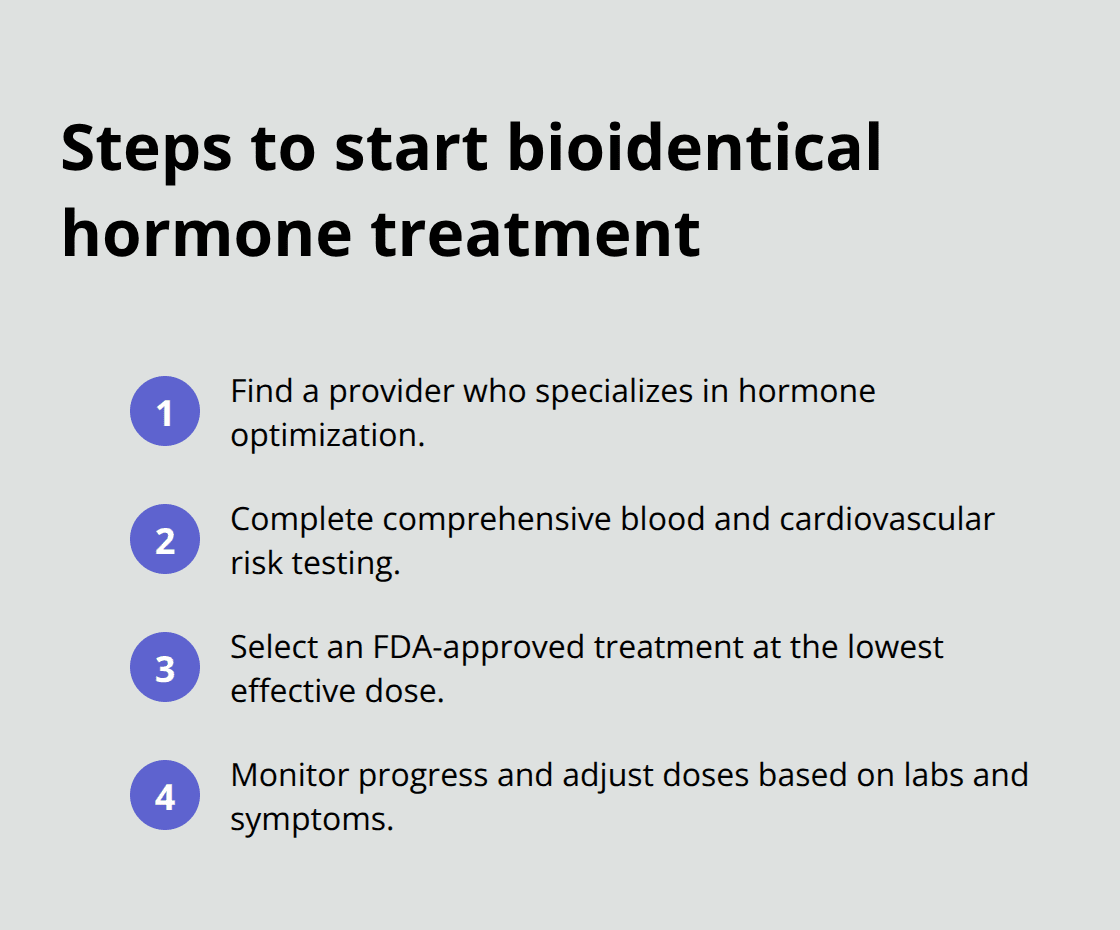
How do you start bioidentical hormone therapy in Bradenton?
Start with a visit that reviews your symptoms, your personal and family history and your labs before anything is prescribed. At Mosaic Medicine on State Road 64, the first visit is a $99 consult that runs 45 to 60 minutes, with history, an exam and a lab plan. Blood is drawn in the same building, and results are reviewed with you by telehealth.
If treatment fits, the plan can include estradiol, progesterone and, where your labs support it, testosterone, dosed from your results. The women’s hormone program is $299 a month plus medication. Whoever you see, ask one direct question: is this prescription FDA-approved or compounded, and why that one for me?
Common questions
Is BHRT FDA-approved?
Some of it is. Bioidentical estradiol and micronized progesterone are FDA-approved in several forms. Custom compounded creams, troches and pellets are not.
Is progesterone the same as a progestin?
No. Progesterone is the hormone your body makes, and micronized progesterone is the bioidentical version. Progestins are synthetic molecules that act on the same receptors but aren’t identical.
Do I need progesterone if I take estrogen?
If you still have a uterus, yes. Estrogen alone thickens the uterine lining, and progesterone protects it. Women who’ve had a hysterectomy usually take estrogen alone.
How long is it safe to be on bioidentical hormones?
There’s no fixed limit. The Menopause Society doesn’t set a stop date and suggests reviewing the plan each year against your symptoms, age and health. Some women stop within a few years, and others continue past 60 after a fresh look at the risks.
What is the healthiest form of HRT?
There isn’t one form that’s best for everyone. A common choice is estradiol through the skin as a patch or gel, because it carries a lower clot risk than tablets, plus micronized progesterone if you have a uterus. For dryness alone, low-dose vaginal estrogen acts mostly where it’s applied.
Should a 65-year-old woman take estrogen?
It depends on when she started and why. Continuing estrogen past 65 can be reasonable for a woman whose symptoms persist and whose risks have been reviewed. Starting for the first time at 65 carries higher risks of stroke, blood clots and heart disease, so it’s approached with more caution. Vaginal estrogen for dryness is a different, much lower-dose decision.
Where to start
Bioidentical hormones are a reasonable choice when they’re FDA-approved, dosed from your labs and checked again after you start. You can book a women’s hormone evaluation in Bradenton, read how menopause treatment works at Mosaic, or call (941) 777-5665.
