

If you’re considering membership-based healthcare, you’ve likely heard both terms thrown around. Direct primary care and concierge medicine sound similar, but they work very differently, especially when it comes to cost and how your care gets billed.
At Mosaic Medicine Clinic, we believe understanding these distinctions matters. The right choice depends on your budget, your health needs, and how much direct access to your doctor you actually want.
Direct Primary Care vs Concierge Medicine: How Direct Primary Care Actually Works
The Core Model: Membership Instead of Insurance Billing
A direct primary care practice strips away the insurance middleman entirely by using a flat monthly fee that covers most primary care services. Instead of your insurance company receiving a bill for every visit, you pay a Flat monthly fee, typically between $50 and $200 depending on your age and coverage level, and that covers most of your primary care needs. A family plan might run around $240 monthly. This model fundamentally changes how doctors practice. Without insurance paperwork consuming hours, physicians in DPC do not bill insurance for routine care, so they spend less time on coding and billing and more time with patients, which supports more proactive care, aligning with the core principles of direct care in healthcare. Physicians in DPC practices report significantly higher take-home pay, improved work-life balance, and reduced administrative burden. That matters because your doctor isn’t rushing through 40 patients a day just to stay financially viable. The traditional primary care visit averages around 18 minutes according to the NIH, but DPC appointments typically run 30 minutes or longer because smaller patient panels and fewer patients allow more time per visit and help build strong doctor patient relationships.
What Your Membership Actually Covers
What you receive with DPC membership is comprehensive, typically including preventive care and chronic disease management. Same-day or next-day appointments become standard, with same day access no longer a luxury. You gain 24/7 access via text, phone, or email for direct communication and immediate access to discuss concerns without waiting for office hours. Most DPC practices include basic lab work and in-office procedures as part of your membership, with costs kept low through wholesale pricing-blood tests often run $40 to $60, and chest X-rays might cost around $50 when paid directly. For more complex tests, specialist visits, or referrals for specialty care, you’ll typically pay separately, though many DPC patients pair their membership with high-deductible plans since it does not replace insurance or a health plan for catastrophic coverage. This hybrid approach provides predictable monthly direct primary care costs for routine care while maintaining protection against major medical events.
Transparency and Cost Control
Mosaic Medicine Clinic emphasizes transparent, affordable direct primary care in Bradenton on every cost, offering wholesale labs, at-cost imaging, and discounted medications so you know exactly what you’re paying. The result is that patients experience shorter wait times, longer visits, and genuinely personalized care plans that support better patient care through a more personalized healthcare approach, not cookie-cutter protocols designed to maximize insurance billing. This straightforward pricing structure eliminates surprise bills and hidden fees that plague traditional insurance-based care. Patients can budget for healthcare with confidence, knowing their monthly membership covers the vast majority of routine medical needs and improves the overall healthcare experience. Now that you understand how DPC operates, the question becomes: how does this compare to concierge medicine, which takes a fundamentally different approach?
How Concierge Medicine Works Differently
In comparing concierge medicine vs direct primary care, concierge medicine operates on a fundamentally different financial model, and this distinction shapes everything about how it functions. Instead of replacing insurance entirely, most concierge practices operate within the existing insurance system and layer a membership fee on top of traditional insurance billing. You pay an annual fee—often structured as an annual retainer fee—that typically ranges from $2,000 to $10,000 or more, then continue paying copays, deductibles, and out-of-pocket costs when you visit or receive services. Concierge physicians typically care for just 400–600 patients, which enables same-day or next-day appointments and extended visits.
The Two-Payment Reality
The financial reality proves more complex than DPC, especially when you examine how much direct primary care typically costs. A patient seeking care for a chest issue in a concierge practice might face a $1,285 total cost when combining the annual membership fee plus insurance-based charges for visits and imaging. Compare that to a DPC scenario totaling around $225 with membership plus in-clinic labs and imaging included, and the cost difference becomes stark.
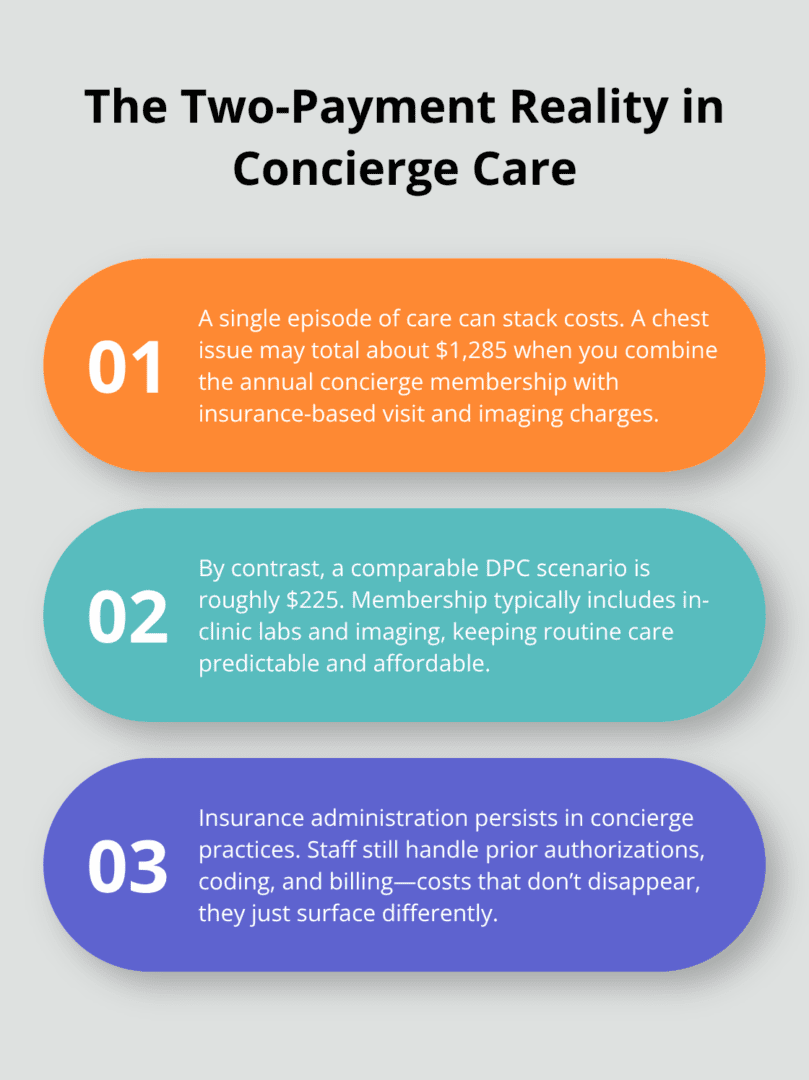
Concierge medicine typically maintains insurance relationships, and many practices accept insurance under a patient’s health insurance plan and bill insurance for covered services while also charging additional membership fees, which means your physician’s office staff still manages insurance paperwork, prior authorizations, and coding complexity. This administrative involvement doesn’t disappear; it simply gets paid differently.
Who Concierge Medicine Targets
The concierge model targets affluent patients, local employers, and small business owners who prioritize convenience and premium services above cost predictability, in contrast to the pros and cons of direct primary care that emphasize affordability and simplicity. You pay for luxury-level amenities, enhanced access features, and often a broader range of diagnostic services included in the membership package. The concierge membership promises 24/7 physician availability, personalized care coordination, personalized service, and sometimes house calls that sound appealing, but the ongoing insurance billing creates financial unpredictability that contradicts the membership concept.
Real-World Cost Examples
A pediatric sore throat case illustrates this pattern clearly: DPC charged only the monthly membership of approximately $50, while a concierge plan totaled about $310 when combining membership plus copays and tests. This pattern repeats across most health scenarios because the membership fee doesn’t reduce your insurance-related costs. Concierge practices often advertise bone density scans, advanced preventive screenings, and other premium services as membership benefits, but these may still generate claims through health insurance and out-of-pocket expenses, which contrasts with the benefits of direct primary care for overall health and its clearer cost structure.
When Concierge Makes Sense
The model works best for high-income patients with complex medical needs who want a primary care doctor with immediate access and don’t mind the insurance involvement or variable costs. For families or individuals on moderate budgets, the combination of a monthly or annual fee plus ongoing insurance charges creates financial surprises that DPC eliminates, which is why many ask whether direct primary care is worth it as an alternative to traditional insurance-based models. The fundamental difference isn’t about care quality; it’s about who bears the administrative burden and who pays the price. In concierge medicine, you pay premium prices for premium convenience. That approach appeals to a specific demographic, but it leaves many patients seeking a simpler, more transparent alternative, which brings us to the key differences that should shape your decision.
Key Differences Between Direct Primary Care and Concierge Medicine
The Financial Reality: Cost Structures That Diverge Sharply
The financial gap between Direct Primary Care and concierge medicine isn’t subtle-it defines who can actually afford each model. Direct primary care (DPC) membership costs between $50 and $200 monthly depending on your age group, with family plans around $240 per month, making it the lower-cost model for routine care. Concierge membership runs $2,000 to $10,000 annually, often reaching $250 to $750 monthly, and patients still need a health insurance plan alongside concierge or DPC for non-primary-care expenses, before you pay a single copay or deductible. The New England Journal of Medicine reported in 2025 that DPC practices operate with pricing transparency and predictable costs, while concierge practices still generate insurance billing on top of membership fees. This two-tier payment system in concierge care means a routine chest issue costs approximately $1,285 total, whereas the same situation in DPC runs roughly $225. For a pediatric sore throat, DPC patients pay only about $50 through membership, while concierge patients face $310 when combining membership, copays, and diagnostic tests.
Insurance Paperwork: The Hidden Cost of Concierge Care
Concierge practices maintain full insurance involvement, meaning your physician’s office staff still manages prior authorizations, coding requirements, and billing disputes. This administrative complexity doesn’t vanish; it simply sits underneath the membership fee. DPC practices bypass this entirely by operating outside insurance billing for primary care services, reducing administrative overhead so significantly that physicians report taking home more income while working fewer hours. The New England Journal of Medicine noted that concierge doctors typically see 400–600 patients, while DPC physicians maintain larger panels but still far below the traditional 2,000-plus patient load. However, the key difference isn’t panel size-it’s administrative burden. Concierge practices promise premium convenience while keeping you tethered to insurance complexity; DPC practices deliver genuine simplicity. Insurance involvement in concierge care creates the exact financial unpredictability that membership-based healthcare should eliminate.
Access and Affordability: Who Each Model Actually Serves
Concierge medicine explicitly targets affluent patients who can afford premium annual fees and don’t object to ongoing insurance interactions. DPC serves families and individuals seeking straightforward, affordable care compared with many traditional primary care practices, without wealth requirements. The accessibility difference matters because healthcare shouldn’t depend on your income level. DPC’s lower cost structure makes quality physician access available to middle-income families, self-employed individuals, and small business employees, while urgent care and urgent care centers remain episodic options that do not replace ongoing primary care. Concierge practices don’t exclude lower-income patients outright, but their pricing structure naturally filters for high-income demographics. For patients with high-deductible health plans, direct patient care through a DPC membership costs less than traditional copay-based care while providing unlimited visits and unlimited access. This practical advantage explains why about 10 percent of family medicine physicians now operate DPC practices according to 2025 data-the model attracts physicians who want to serve broader populations without insurance gatekeeping and with better support for chronic condition management.
Final Thoughts
Direct Primary Care offers something concierge medicine doesn’t: simplicity without compromise, leading many patients to consider whether direct primary care is worth it financially and clinically. When you compare direct primary care vs concierge medicine, the practical advantage becomes clear. DPC removes the financial guesswork that plagues traditional healthcare and gives patients an alternative to rushed visits at a doctor’s office, so you know exactly what you’ll pay each month. That membership covers the vast majority of your primary care needs without surprise bills, insurance paperwork delays, or two-tier payment systems that leave you confused about what you actually owe.
Three honest questions shape your decision between these models. First, what can you realistically afford? Does your family budget accommodate DPC’s $50 to $200 monthly range, or does concierge medicine’s $2,000 to $10,000 annual commitment plus ongoing insurance charges stretch your finances too far? Second, do you want insurance involvement in your primary care, or would you prefer your doctor to focus on your health rather than coding requirements? Third, how much direct access do you actually need, and at what cost (both models offer same-day appointments and physician communication, but DPC delivers this at a fraction of the price)?
We at Mosaic Medicine Clinic in Bradenton, Florida, operate on these exact principles, focusing on building a strong doctor patient relationship through unrushed appointments and direct physician access. Our membership model includes wholesale labs, at-cost imaging, and discounted medications so you see exactly where your money goes. Explore how Mosaic Medicine Clinic can serve your family if you’re ready to experience healthcare without the insurance middleman.