
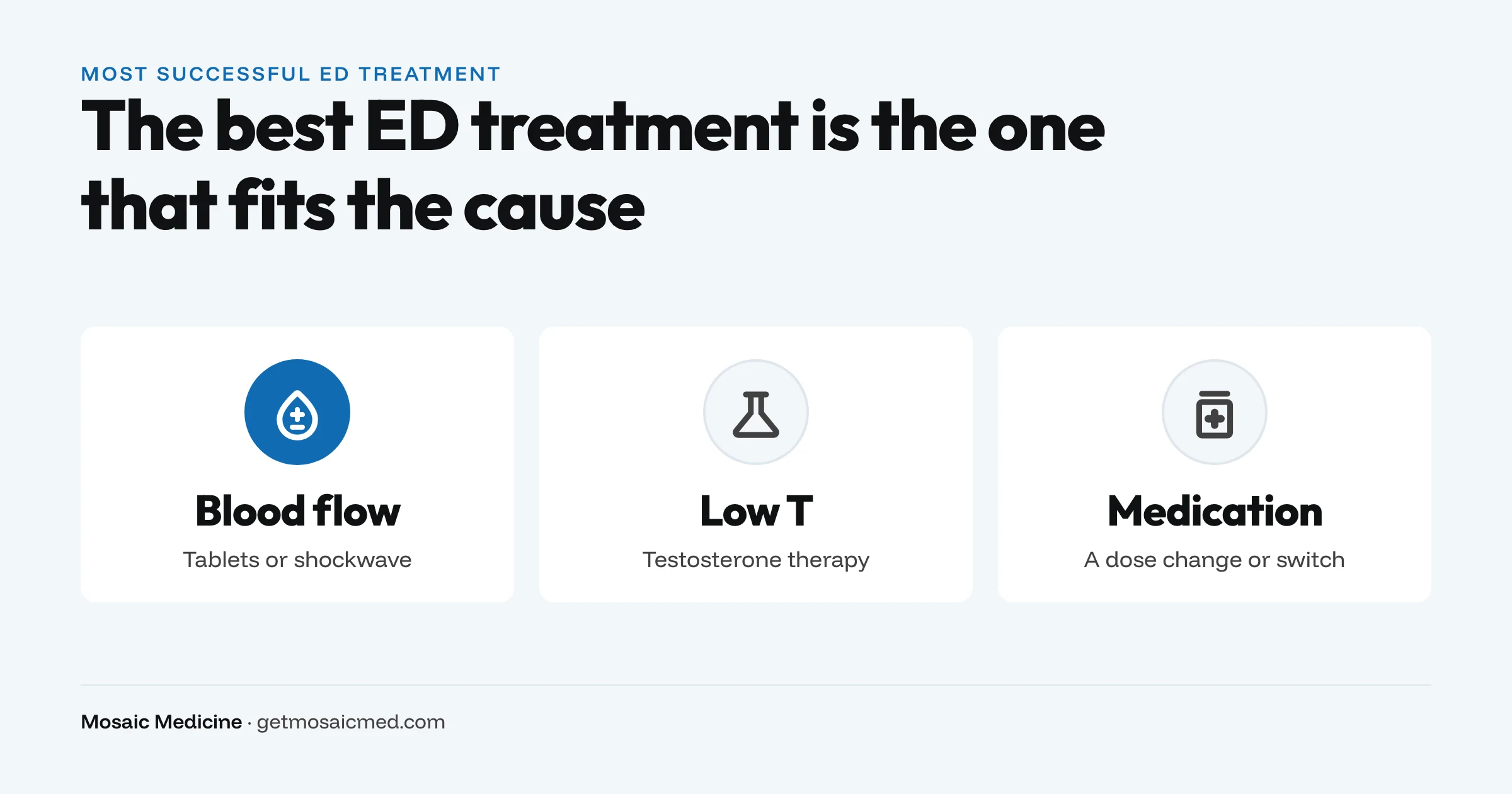
The most successful treatment for erectile dysfunction is the one that matches what’s causing it. Tablets help a lot of men, but they won’t fix low testosterone, a blood pressure medication side effect or a blood sugar problem, and those are some of the most common causes we find in men in Bradenton.
That’s why the answer to “what’s the best ED treatment” is usually a question back: what’s behind yours? Here’s how the main treatments line up against the causes, and how to find out which one is yours.
Why does the cause decide which ED treatment works?
ED treatment works best when it treats the reason the erection isn’t happening. Cleveland Clinic puts it plainly: the first step in treating erectile dysfunction is identifying the underlying cause.
An erection needs blood flow, working nerves and enough hormone drive, all at once. When one of them slips, the treatment has to reach that part. A tablet improves blood flow for a few hours. It does nothing for a testosterone level that’s low, and it can’t undo a medication that’s dulling everything. The National Institute of Diabetes and Digestive and Kidney Diseases says the same thing from the other side: providers treat the underlying cause when they can, and sometimes that means changing the dose of a medicine or switching it.
Which ED treatment matches which cause?
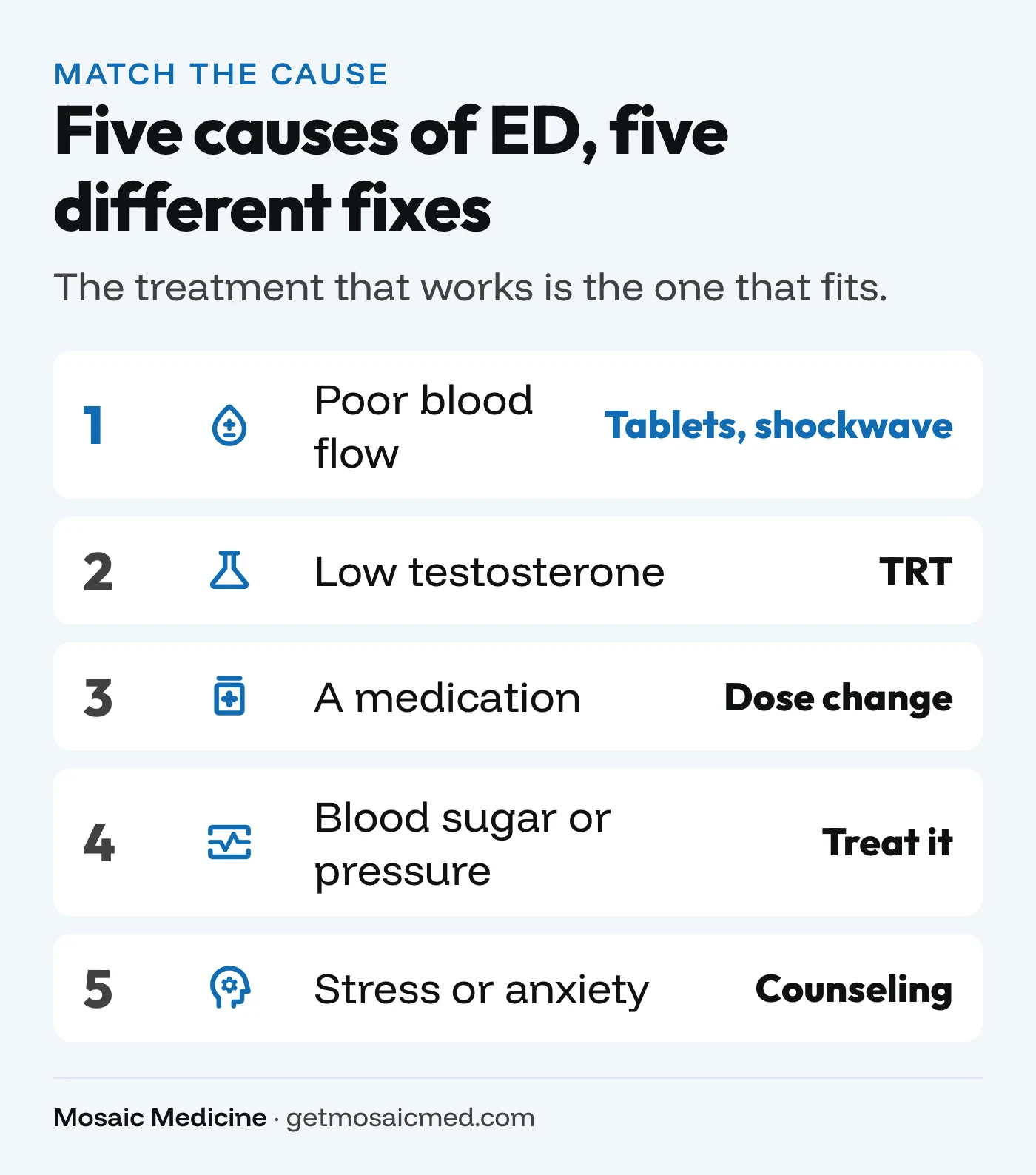
Each common cause of ED has a treatment that fits it, and a few that don’t. This table is the short version of what a first visit sorts out.
| If the cause is… | What usually fits | What won’t fix it on its own |
|---|---|---|
| Poor blood flow | Tablets, and shockwave therapy for some men | Testosterone, if your level is normal |
| Low testosterone (two low morning tests) | Testosterone therapy, often alongside other treatment | Tablets alone, if drive is the problem |
| A medication side effect | A dose change or a switch, made with the prescriber | Stopping the medicine on your own |
| Blood sugar or blood pressure | Treating the condition, plus ED treatment if needed | Any ED treatment that skips the labs |
| Stress, anxiety or the relationship | Counseling, sometimes with a tablet for a while | Shockwave or testosterone |
Most men have more than one thing going on. That’s normal, and it’s the reason a single “best” treatment rarely exists.
Are tablets the best first treatment for ED?
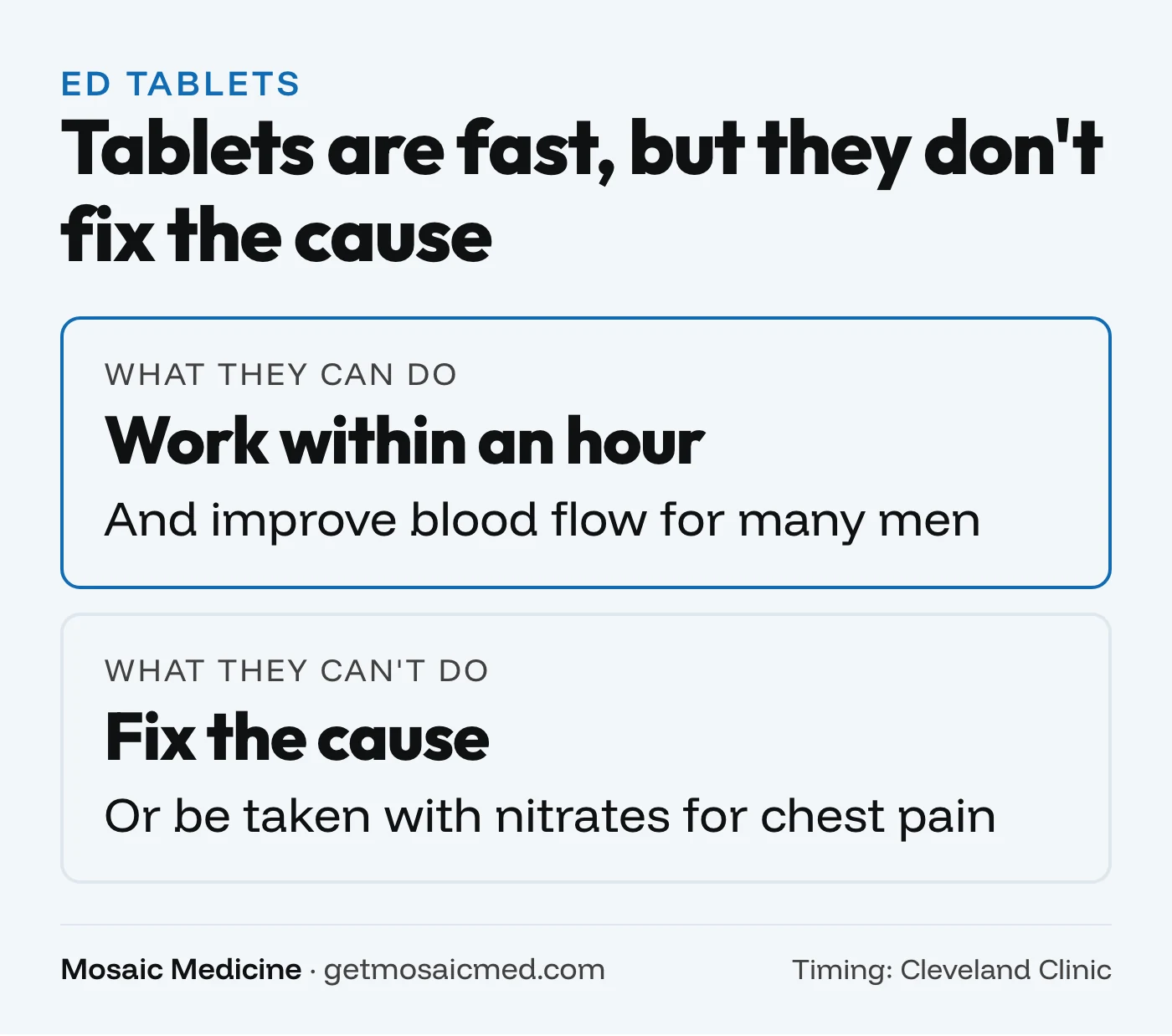
For a lot of men, yes. Daily or as-needed tablets such as sildenafil and tadalafil improve blood flow and work for many men with ED, and they’re usually the simplest place to start.
They have limits worth knowing before you order them. They need arousal to work. They treat the symptom, not the cause, so the reason for your ED is still there when the tablet wears off. And some combinations aren’t safe: these tablets can’t be taken with nitrates for chest pain. If you take heart medication, which is common in a county with as many retirees as Manatee, someone should check your list before you start.
Where does shockwave therapy fit?
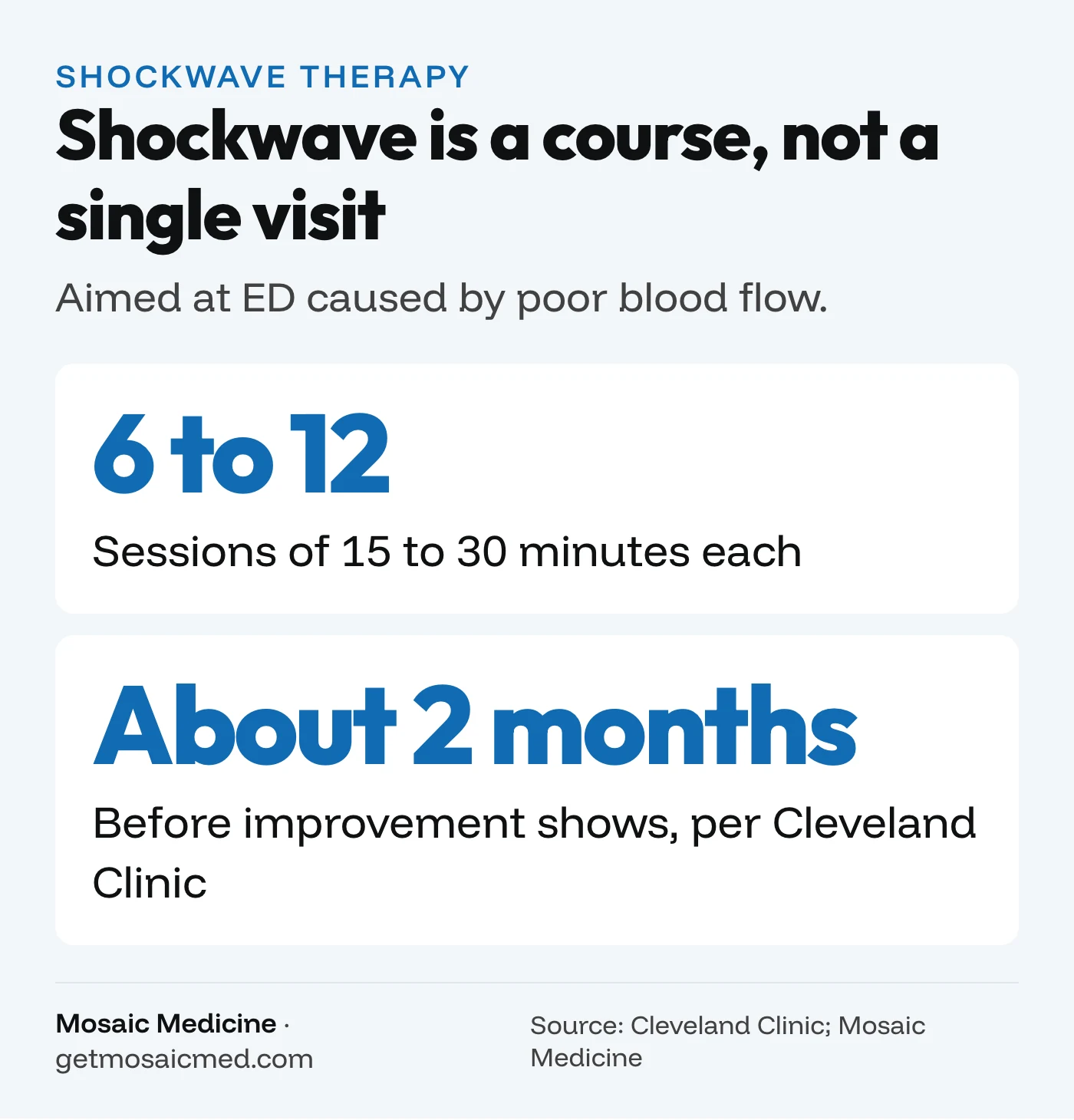
Shockwave therapy is aimed at one cause: ED from poor blood flow. Low-intensity sound waves are delivered to the penis in a series of short office sessions, usually 6 to 12 sessions of 15 to 30 minutes.
It isn’t a first-line treatment everywhere. University of Utah Health describes it as experimental and not yet FDA-approved for ED, and Cleveland Clinic notes it can take two months to see improvement. It doesn’t work for everyone, so the useful question is whether your history points to blood flow before you book sessions. Mosaic offers GAINSWave in Bradenton for men whose evaluation shows it’s worth trying, and what it costs is covered in a separate post.
When does testosterone treatment help ED?
Testosterone helps ED when your testosterone is actually low, which means low on two early-morning blood tests, not one. It mostly works on drive, and that can help erections too.
If your level is normal, adding more won’t fix ED. Testosterone therapy also lowers sperm production, so it matters if you want children. If you’re not sure whether low testosterone is part of the picture, the low testosterone quiz is a quick first check, and the TRT page explains how Mosaic tests before treating.
Is there a permanent cure for ED?
Sometimes. When ED comes from something fixable, such as a medication side effect, low testosterone, poorly controlled blood sugar, heavy drinking or poor sleep, fixing that cause can bring erections back without ongoing ED treatment.
When the cause is long-standing damage to blood vessels or nerves, treatment usually manages ED rather than curing it. Surgery, such as a penile implant, is the most permanent option, but it’s done by a urologist and it’s rarely where anyone starts. NIDDK notes that most people with ED don’t need surgery.
How do men in Bradenton find the right ED treatment?
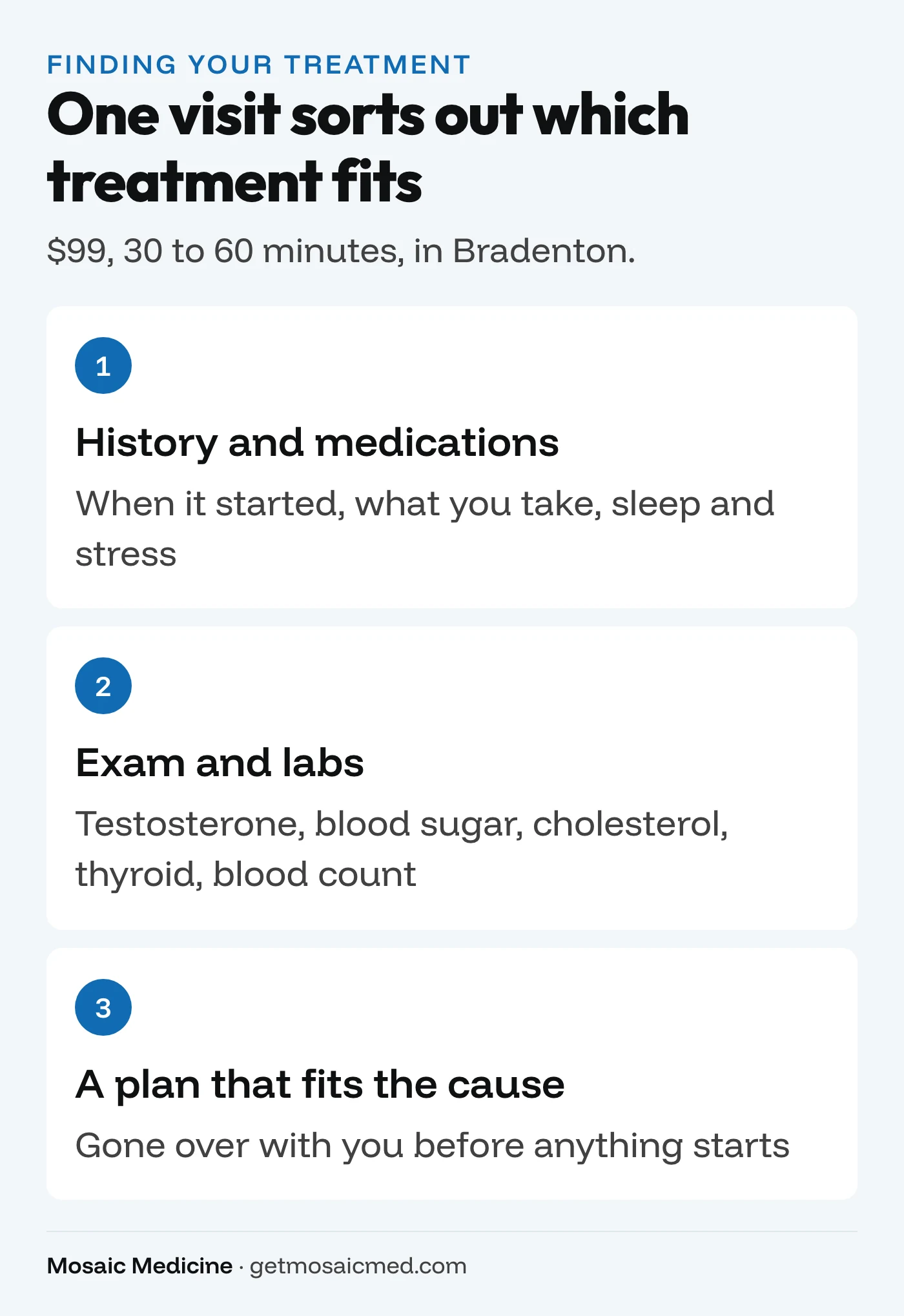
The fastest route to the right treatment is one visit that tests the likely causes together. At Mosaic Medicine on SR 64, the first ED treatment visit is $99 and runs 30 to 60 minutes with Cory Lucas, FNP-C. He goes through your history and medications, does an exam, and orders labs for testosterone, blood sugar, cholesterol, thyroid and a blood count.
That one set of labs often answers the question this post asks. It also catches the things a tablet would cover up. Cleveland Clinic notes that ED can be the first symptom of heart disease, and a man in Lakewood Ranch or Bradenton who finds that out from bloodwork is better off than one who finds out later. If it helps with planning, Medicare Part D doesn’t cover drugs prescribed for ED, which matters for a lot of men here.
The ED forums are full of men who worked through a stack of supplements before anyone checked their blood sugar. Start with the labs instead.
Common questions
What’s the fastest ED treatment?
Tablets work fastest, usually within an hour of taking them. They’re fast because they treat the symptom, so they don’t tell you why the ED started.
How long does shockwave therapy take to work?
Cleveland Clinic says it can take about two months to see improvement. A course is usually 6 to 12 short sessions, so give it the full course before judging it.
Do I need to see a urologist for ED?
Most men don’t, at least not first. A primary care or men’s health provider can test for the cause and start treatment, and a urologist handles injections, implants and problems after prostate surgery.
Where to start
The most successful ED treatment is the one that fits your cause, and you can’t pick it from a list. One visit and one set of labs will usually tell you whether you’re looking at a tablet, shockwave, testosterone or a change to something you already take. You can book an ED evaluation in Bradenton or call (941) 777-5665.
