

Traditional healthcare feels broken to many people. Long waits, surprise bills, and rushed appointments have become the norm.
At Mosaic Medicine Clinic, we’ve seen firsthand how the direct primary care model changes this equation. This approach strips away insurance bureaucracy and puts your doctor’s focus squarely on you.
How Direct Primay Care Cuts Through Healthcare Complexity
Insurance Middlemen Create Unnecessary Barriers
The traditional insurance model forces your doctor to play intermediary between you and a faceless corporation. Insurance companies decide what your doctor can prescribe, how long your appointment lasts, and whether a treatment receives approval. This system was built for efficiency and profit margins, not for your health. abandons this entirely.
In direct primay care, patients pay directly to their doctor’s practice through a flat monthly membership fee, typically between $65 and $85 per month according to the American Academy of Family Physicians. That fee covers your primary care needs without insurance billing and cuts down on insurance paperwork in a direct primary care model. No prior authorizations to fight, no surprise bills arriving months later.
Smaller Patient Panels Mean More Time and Unlimited Access With Your Doctor
Your membership gives you unlimited access to your physician, better access overall, and longer appointments without the clock ticking. The average DPC practice serves around 413 patients per physician, compared to 2,500 patients in traditional fee-for-service practices. This difference matters immensely. Instead of rushed visits built around fifteen-minute slots and insurance-driven productivity targets, your doctor has time to focus on you.
Same-day appointments or next-day scheduling become standard rather than exceptional, making timely care easier to get. Your physician actually knows your medical history, your family situation, and your health goals. This ongoing relationship helps ensure continuity and supports more personalized care in direct primary care, leading to better prevention and earlier intervention when problems emerge.
Transparent Pricing Eliminates Billing Surprises
The pricing transparency in DPC solves a real problem that plagues American healthcare. In traditional medicine, you often don’t know what something costs until the bill arrives weeks later. DPC inverts this completely. Services included in your membership are spelled out upfront, helping patients understand how much direct primary care costs and save money instead of just avoiding surprise bills. Additional medical services like labs or imaging are often priced at cost or wholesale rates, giving patients access at lower costs than the inflated prices hospitals charge to insurance companies.
One North Carolina employer reported saving more than $1.2 million in medical and prescription drug claims during the first year of offering DPC to employees. Those savings came from fewer emergency room visits, reduced hospital admissions, and better chronic disease management. When patients have direct access to their doctor without insurance barriers, they use emergency rooms less and manage conditions more effectively.
Physicians Reclaim Time for Patient Care
The model eliminates the administrative burden that drives physician burnout. Doctors spend less time on tasks required to bill insurance and more time actually treating patients, while simpler operations can also lower overhead costs. This shift in incentives fundamentally changes the quality of care and allows physicians to focus on what drew them to medicine in the first place.
Understanding how membership fees translate into actual services you receive helps clarify whether DPC fits your healthcare needs.
How the DPC Membership Model Works
The membership model strips away complexity and replaces it with straightforward pricing. Typical DPC fees range from $65 to $85 as a monthly fee according to the American Academy of Family Physicians, though some practices also use an annual fee that spreads costs differently. This single fee covers your primary care services, including visits, preventative services, and chronic disease management. With direct primary care, you know exactly what you pay each month, and you know what that payment covers. No separate copays for routine visits, no deductibles hiding behind the scenes, no bills arriving three months later for services you thought were included.
This predictability matters most for people managing chronic conditions like diabetes or hypertension who need regular monitoring. Instead of worrying about whether your next appointment will trigger unexpected costs, you focus on actual health management.
What Your Membership Actually Includes
Your membership covers the core medical services that solve real healthcare problems. Unlimited office visits with same-day or next-day scheduling come standard, improving easy access and patient access in a way that changes how you interact with your doctor. Preventive care like annual physicals, blood pressure monitoring, and age-appropriate screenings are included without additional charges.
Chronic disease management sits at the center of what DPC practices do well, since physicians have time to develop real care plans rather than rushing through fifteen-minute slots. Care coordination, lab interpretation, and medication management are built into your membership, which also makes direct primary care an affordable option compared to traditional insurance-based practices. Additional services like laboratory tests and imaging work differently in the DPC model.
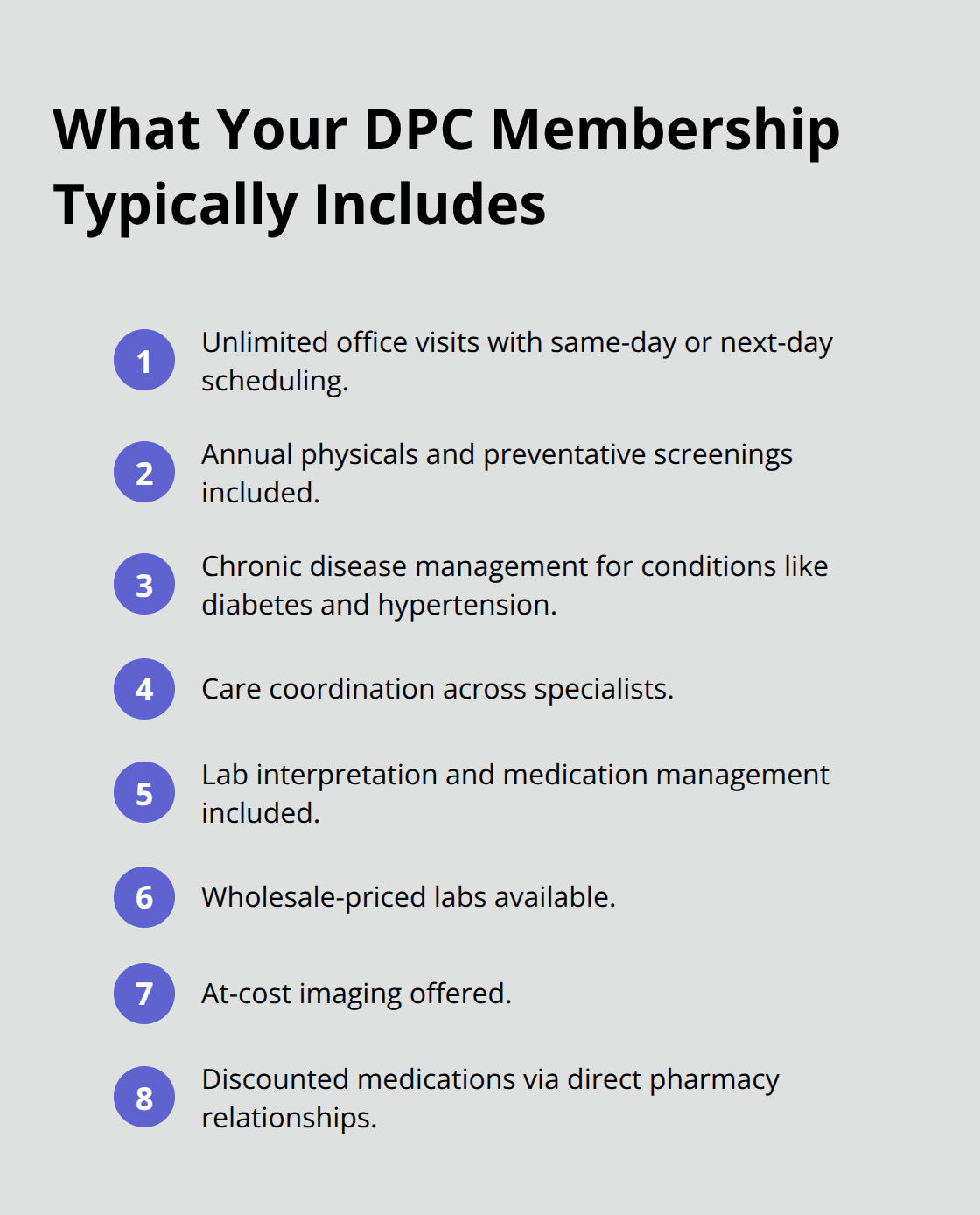
Practices provide wholesale labs and at-cost imaging rather than the inflated hospital prices. This approach saves patients substantially on necessary testing while maintaining quality. Medications also benefit from transparency, with practices offering discounted rates through direct pharmaceutical relationships and better access to common medications rather than insurance markup layers.
Services Outside Your Membership and How They’re Priced
Some services fall outside the membership scope and require separate discussion. Procedures like biopsies or excisions, which the American Academy of Family Physicians identifies as common DPC services, are typically charged separately at transparent rates disclosed upfront. Specialty referrals happen regularly, especially when patients need specialty care that goes beyond primary care or expertise across specific medical specialties. But here’s where DPC practices differ meaningfully: your primary care physician coordinates your care, advocates with specialists, and helps ensure continuity rather than disappearing after a referral, which is an important consideration when you set up a direct primary care arrangement. This coordination reduces unnecessary testing and duplicate visits that plague traditional care.
Emergency room visits and hospital admissions obviously fall outside membership coverage, which is why most DPC patients pair their membership with a high-deductible health plan that covers catastrophic events. The combination works because DPC reduces unnecessary ER visits through better preventative care and direct access. That Union County, North Carolina, employer saved over $1.2 million partly because employees visited emergency rooms less frequently when they had direct physician access.
How Incentives Align in the DPC Model
The membership model works because it aligns incentives correctly and supports a more patient centered relationship. Your doctor benefits when you stay healthy and protect your long-term well being, not when you consume more services, which fundamentally changes the entire relationship. This shift means your physician focuses on prevention and early intervention rather than treating advanced conditions that generate more billable events. When you understand how these financial incentives work, you can see why DPC practices invest time in building a meaningful relationship with patients-your long-term health directly supports their practice sustainability. Understanding whether DPC fits your specific healthcare situation requires looking at what happens when you need care beyond primary medicine.
Why People Switch to Direct Primary Care
Physicians Abandon Traditional Medicine for DPC
Frustration with traditional healthcare runs deeper than inconvenience. A 2023 American Academy of Family Physicians survey found that 9% of family physicians now operate DPC practices, up from just 3% in 2022. This rapid shift reflects something real: physicians are voting with their feet, and patients are following. The reasons are concrete and measurable.
In traditional fee-for-service medicine, your doctor often has to see many patients, which means less time for each visit. Insurance companies dictate treatment protocols, deny prescriptions they deem unnecessary, and create administrative burden in healthcare that consumes roughly 25% of healthcare spending according to Harvard Medical School research. Physicians spend hours fighting prior authorization battles instead of talking to patients.
A Doximity poll of 946 physicians showed 52% now support DPC, with the strongest backing among family medicine practitioners at 57%. These aren’t fringe doctors experimenting with an unproven model. They’re mainstream physicians exhausted by a broken system and choosing to do things differently.
Patients Gain Immediate Financial Clarity
For patients, the switch solves tangible problems immediately because DPC can help them save money. Your monthly membership fee between $65 and $85 means no copays, no deductibles, no surprise bills. That predictability matters enormously for managing chronic diseases, while supporting accessible care as part of the overall value. Someone with diabetes or hypertension knows exactly what they pay monthly and can focus on health instead of healthcare costs.
A 2023 analysis found that patients pairing DPC membership with high-deductible health plans achieve lower costs of 20–30% compared to traditional insurance, partly because direct patient care and direct physician access prevent unnecessary emergency room visits that drain both wallets and time. You receive no surprise bills months after appointments because DPC practices charge transparent rates upfront rather than negotiating hidden rates that bear no relationship to actual costs.
Your Doctor Actually Remembers You
The relationship transformation separates DPC from every other healthcare model. Your physician serves a patient panel of roughly 413 people instead of 2,500, with that patient panel intentionally small so they actually remember your health history, your family situation, and your goals without scrolling through electronic records. This continuity drives better outcomes.
When your doctor knows you’ve struggled with medication compliance or that your work stress triggers migraines, they and your care team can tailor treatment accordingly rather than following protocol. Longer appointments without time pressure allow for conversations that prevent problems instead of just treating them after they develop. This isn’t abstract improvement. It’s the difference patients feel between direct communication when you call your doctor at 4pm with a question and get a same-day response versus waiting a week for an appointment only to be told to visit urgent care.
Employers Recognize Measurable Cost Reductions
Employers increasingly recognize these benefits. Union County, North Carolina reported saving more than $1.2 million in year one after offering DPC to employees, driven by fewer emergency room visits and hospital admissions. Small and mid-sized businesses find DPC particularly valuable because it provides predictable healthcare costs without the year-to-year premium increases that plague traditional insurance.
Employees report higher satisfaction because enhanced access means they can actually reach their doctor when needed, not weeks later, which also supports a healthier life over time. Predictable healthcare costs allow businesses to budget accurately instead of absorbing surprise premium hikes that erode profit margins.
The Model Appeals Across Physician Demographics
Women physicians show slightly higher DPC support at 55% compared to men at 50% according to Doximity, suggesting the model appeals to practitioners across demographic lines. The shift accelerates because the problems it solves are undeniable: administrative burden, cost opacity, rushed care, acute care gaps, and misaligned incentives. DPC practitioners eliminate these friction points systematically by removing insurance intermediaries, simplifying billing, and building practices around time with patients rather than transaction volume.
Final Thoughts
The direct primary care model solves problems that traditional healthcare ignores. Insurance bureaucracy, surprise bills, rushed appointments, and misaligned incentives wear down both patients and physicians. DPC strips away these barriers and replaces them with straightforward relationships built on time, transparency, and shared health goals. Unlike concierge practices, which often resemble concierge care and serve a more premium market, DPC remains distinct from concierge medicine by emphasizing accessible membership-based primary care, and patients comparing options should understand the key differences between direct primary care and concierge medicine as well as how direct primary care vs concierge medicine affects cost, access, and the type of care they receive. When you switch to DPC, you gain immediate clarity about costs, schedule same-day or next-day appointments with a physician who knows your medical history, and manage chronic conditions without fear of surprise bills.
For employers, DPC delivers measurable financial benefits. Union County, North Carolina, saved over $1.2 million in year one by offering DPC to employees, driven by fewer emergency room visits and better chronic disease management. Small and mid-sized businesses find the predictable costs particularly valuable when traditional insurance premiums increase unpredictably each year. The direct primary care model fundamentally changes how organizations approach employee health and budget stability.
At Mosaic Medicine Clinic in Bradenton, Florida, we’ve built our practice around these principles. We focus on building strong patient-doctor relationships through unrushed appointments, direct access to physicians, and personalized care, with transparent pricing on labs, imaging, and medications that reflect how direct primary care works and what direct primary care means for your healthcare. Whether you’re an individual, family, or small business seeking healthcare that actually works, visit Mosaic Medicine Clinic to learn how the direct primary care model puts your health first.